Memories are confusing to me. Plain and simply – confusing:
I remember. Strong, vivid memories…
But then……I don’t remember.
But then…. maybe I do.
No. No. NO. I REMEMBER.
Hold on. HOLD ON, Melissa. You can’t just put stuff in that didn’t happen. I mean….if it didn’t happen…it didn’t happen.
Maybe I can to talk to someone else who was there – maybe they’ll be able to help me remember. I don’t want to create something that wasn’t there.
NO. I REMEMBER.
But…wait. I KNOW that I put some pieces in so that people could REALLY understand the weight of what happened…sometimes the facts don’t give enough credence to their impact. So how do I tell this journey pressing against my skin???
One of the things that has held me back from writing my story has been my own self-awareness — do I write what I feel about my past regardless of how the facts have diminished in importance while the emotions they left behind have burgeoned and forged their own truth? Do I tell a fact-based story of this-happened-then-that-happened – one that can be read by those who witnessed it and be confirmed by them? Do I have to write a story devoid of the vibrant authenticity that exists in my personal recounting? Is it possible to honor all the other survivors, many with more horrific recountings, while still expressing how impactful my own personal life history was?
I don’t want to tell a story that is untrue, but where is the line between validity through witness and validity through authenticity?
The story that I feel compelled to tell is a story where the minutia of who and what and when and where fades under the luminance of my personal truth of experience. Where I have landed after a many years’ long battle is this: I will cause some who were alongside me consternation, confusion, moments of “what-the-f- is-she-talking-about”; it may cause people to point out all the places where my recollections are far from the reality that they experienced, or maybe even happened or didn’t. It is not my goal to tell this story as one of auto-biography, but rather one of experiential-memoir: the vulnerable, inner workings of my joys, my traumas and their impact. The warping of truth, the insertion of plain and simple fabrications that happen to those of us who have been forced to survive, have created the memory of my past. My imagination has often become the very thing that has held me through, and yet has undermined my confidence in the retelling of events. I have decided that I will not betray my conceptions and interpretations in the narrative of my story, because without them, there is only a 30 page essay on the struggles of being human.
As you read what I write, please keep this in mind: I am writing my experience – with all its fallacies and wins and coping mechanisms. You can decide whether you want to know the “factual truth” or whether you will accept the words I say as “my truth”. You can decide what pieces you accept as meaningful (negative or positive). You get to take what I write in the very way I learned to live in fullness, in hope, and in “authenticity”: YOU have control over how you experience my way of expressing. Sometimes necessity is the mother of invention, and the most inventive thing we were given as humans is our ability to create a world where things make sense for US and OUR pain – whether that’s with endless reciting of facts or whether it’s what our body and mind and psyche feel safe recounting or somewhere in between.
A small sob broke out a few pews back from me. I glanced over to my mother, who was also huddled over in prayer, her forehead pressed against the back of the pew in front of us. Her back curved and her right hand reached above her head. I could barely reach the next pew without tipping off the one I sat in, but the navy blue hymnal that was held in the restrains of its holder provided me the same support that the greasy, sticky wood gave her. I could smell the paper leaves as my right hand brushed rhythmically through the pages: the restricted “fllllllpppppp” of the fibers beneath my fingers. My head was against the binding that was just heavy enough to support me, but light enough so that the pages could still float between its bindings. The sanctuary hummed with a scary, premonitory weight.
Another series of sobs.
I glanced at Mom. Without opening her eyes, she reached her hand to my thigh: “It’s ok. God is moving.”
Dad sat next to her, straight upright, fidgeting. His eyes were closed in prayer, but his mouth didn’t move. His body was stiff: jaw clenched. In his lap lay his Bible, warped, curling and frayed from years of thumb flipping and fervent following of our faith; a testimony of his dedication to our family – though my gut knew not from dedication to the man who currently stood at the front of the congregation.
Sobs turned into wails.
I looked again at my mother. She maintained her ardent commitment to prayer, while furthering her comforting caresses.
To my left sat my sister. She was in contrite quiet – not praying like my mother, but also not staunchly stiff like my father. She just simply sat. Breathing. Heavily.
The wailing grew.
I knew I couldn’t sit up and look to see where it was coming from, but I knew that cry. I’d heard it before. I knew who it was, and knew what would happen next. Soon the person emitting the gut wrenching wails would be surrounded by a sea of women in leadership…the rest of us kids glad it wasn’t OUR parent, and in the same moment feeling the crush of shame hitting her three children…and what if we were next?
But then again, maybe this would make things at home better for them! Maybe she won’t be so awful and crazy to them! I’d heard stories…
As if on cue, I spotted two of the elder’s wives stand up from their seats from opposite sides of the sanctuary, and make their way toward the seats behind us, calmly and quietly supplementing to God in words I didn’t understand – their tongues arriving before their bodies did. I adjusted my position, stealing a look behind me.
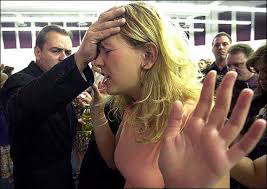
She was sitting upright, her back against the pew, the back of her head at a parallel to the floor. One of the Sisters had her left hand on Marion’s abdomen and her right hand on her left shoulder. Another woman stood behind her, cupping Marion’s head in her hands. Yet another elder’s wife’s finger tips where pressing vehemently on her forehead – Marion’s back was arched as if it was double jointed as she succumbed to the pressure. The pastor’s wife, Florence, was bent over – her mouth directly next to Marion’s ear – a tight grasp on each of her wrists. With every word she spoke, she thrust Marion’s hands in whatever direction she desired. Yelling and screaming angel language – “tongues” we called them. Marion’s body twisted underneath the physical control of these four. I hid my head, breathing deeply, inhaling the scent of the hymnal – a fragrance of dust and paper that had become my comfort.
Help. I’m scared. I still feel terror. Stop it. Someone stop it.
Marion’s wails turned into something I didn’t recognize. I wasn’t even thinking about her kids anymore. They were only a few years younger than me, and I was too scared to think about how they were feeling…I could only think about what would happen to ME if this happened to MY mom. What if MY mom was a sinner like theirs was?
As the congregation swelled in volume with prayers through the languages of men and of angels, I sought solace in my mother. Reaching over and hunting for her hand through my closed, fearful eyes. I found it. Her bony, veiny hand wrapped around mine, squeezing hard. I cracked my eyes open and looked at her, realizing I hadn’t heard a sound out of her since Sister Abbott had walked from the podium and approached the back left of the congregation where Marion sat in all her vulnerability.
I squeezed again and whispered, “I Love you, Mommy.”
She was silent. Squeezing my hand, silent tears, and heavy breathing. My dad’s eyes were open now, and he was shifting from hip to hip. His jaw grinding. I knew he was going to walk out. No one ever stopped him. Why? What made him different? Why could he do that??? NO ONE STOPPED HIM.
“It’s ok, Missy. This isn’t right, but we have each other. And we have our faith. Jesus will make things right. She is hurting and needs Jesus.”
I glanced down at the notebook next to me, the one where I counted how many times the pastor spoke about specific words:
Jesus: 57
God: 89
Lord: 45
Damnation: 125


Leave a Reply